
Advancing Laser Plastic Welding in Ireland Through APT Partnership
Ireland now has local access to laser plastic welding feasibility testing, following the installation of the EvoWELD Mini system at the Applied Polymer Technologies (APT) Gateway at TUS Athlone. This development provides polymer manufacturers, particularly those operating in Ireland’s strong MedTech and precision manufacturing sectors, with the opportunity to evaluate laser welding technology without sending components overseas for validation.

Why Laser Plastic Welding in Ireland is Gaining Adoption for Polymer Manufacturing
Laser plastic welding has seen increasing adoption across medical device manufacturing, automotive sensor production, electronics housings and other precision polymer applications. The process enables two thermoplastic components to be joined using a controlled laser beam, typically in a through-transmission configuration where the upper component is transparent to the laser wavelength and the lower component absorbs the energy. Alternative laser technologies from Evosys include EvoClear and Evo2Step.
Compared to adhesive bonding, laser welding removes curing times, eliminates consumables and reduces variability associated with manual application. In comparison with ultrasonic welding, it introduces significantly lower mechanical stress into the component, making it particularly suitable for delicate assemblies, thin-walled geometries and parts containing sensitive internal features.
For manufacturers operating in regulated sectors such as medical device manufacturing, process repeatability and cleanliness are critical. Laser plastic welding offers precise energy input, controlled melt behaviour and a high degree of process monitoring capability, all resulting in particle-free IP-rated sealing. These characteristics have driven its adoption in applications where hermetic sealing, cosmetic finish and structural integrity are all essential.
With Ireland’s polymer manufacturing base heavily weighted towards MedTech and medical device manufacturing, access to this technology locally represents a meaningful step forward.
Introducing the EvoWELD Mini at APT Athlone
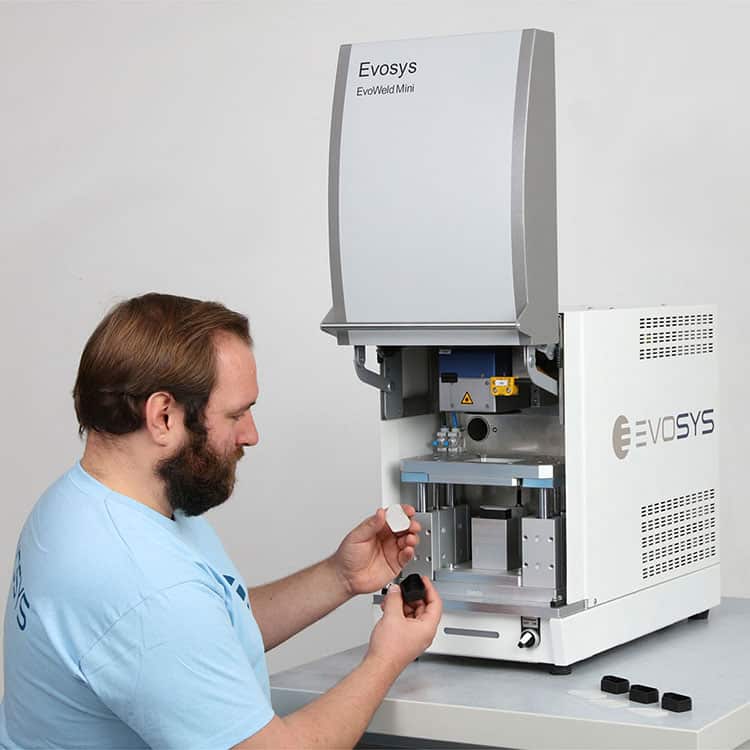
The EvoWELD Mini, developed by Evosys Laser GmbH, is a compact tabletop system designed specifically for laser plastic welding of prototypes, laboratory samples and small series production. Despite its compact footprint, the system integrates the laser source, cooling, beam shaping optics and control components within a single enclosed housing.
The system complies with laser class 1 safety standards, meaning no additional protective enclosures are required during operation. This makes it particularly suitable for research and development environments such as APT.
Technically, the EvoWELD Mini is equipped with a galvanometer scanner, enabling contour and quasi-simultaneous welding processes. Contour welding follows a defined weld path sequentially, while quasi-simultaneous welding rapidly scans the entire weld geometry multiple times, delivering uniform heat distribution across the joint.
Process programming is carried out using Evosys’ EvoLaP software, which allows welding contours to be defined and parameters adjusted with precision. Importantly, welding processes developed on the EvoWELD Mini can be transferred to larger, more automated Evosys production systems with minimal effort. This scalability ensures that the feasibility work carried out at APT can form a reliable foundation for future production implementation.
What This Means for Irish Manufacturers
The presence of the EvoWELD Mini at APT enables Irish manufacturers to carry out material and component feasibility testing locally. Instead of committing to capital investment or international sample shipping at an early stage, companies can evaluate whether laser plastic welding is appropriate for their application within Ireland.
This reduces technical risk and accelerates development timelines. Design iterations can be tested more rapidly, material combinations assessed, and weld strength or cosmetic outcomes evaluated in a structured manner.
For manufacturers exploring new product lines, redesigning existing assemblies or assessing alternatives to adhesives or ultrasonic welding, this local capability lowers the barrier to investigation.


Laser Plastic Welding vs Adhesives and Ultrasonic Welding
When comparing joining technologies, it is important to understand where laser welding offers advantages and where alternative methods may remain appropriate.
Adhesive bonding can introduce variability through application method, cure time and environmental sensitivity. It also introduces consumable materials into the assembly process. Laser plastic welding eliminates curing time and creates a welded joint without additional substances.
Ultrasonic welding, while widely used, introduces mechanical vibration into the part. For delicate medical components or parts with integrated electronics, this can present design constraints. Laser welding applies energy directly at the joint interface, reducing mechanical stress on the overall assembly. The other advantage of using lasers is that it results in particle-free, fully hermetic sealing. Clean and strong welds to these high standards are difficult to achieve with other methods.
In addition, laser welding provides clean external surfaces, often resulting in improved cosmetic finish. For many medical device housings and fluid-handling components, this is a significant advantage.
Designed for Medical, Automotive and Precision Plastics
The EvoWELD Mini supports applications across automotive, medical and consumer sectors. In Ireland, this aligns particularly well with the medical device manufacturing cluster, where high precision polymer assemblies are common.
Typical applications include sensor housings, fluid reservoirs, microfluidic components, electronic enclosures and sealed medical device casings. The ability to achieve precise, repeatable welds without introducing contamination supports compliance-focused manufacturing environments.
While MedTech represents a major segment of Ireland’s polymer industry, other sectors such as automotive sub-supply and electronics manufacturing, will also benefit from evaluating laser welding as a joining solution.

From Prototype to Production
One of the advantages of the EvoWELD platform is process scalability. Welding parameters developed on the EvoWELD Mini can be transferred to higher automation systems within the Evosys portfolio. Optional extensions for process and quality monitoring are also available, supporting the transition from development to production.
This ensures that feasibility testing at APT is not an isolated laboratory exercise, but part of a potential pathway towards industrial implementation.
How to Arrange Laser Plastic Welding Feasibility Testing in Ireland
Manufacturers interested in exploring laser plastic welding in Ireland can engage with TLM Laser to discuss feasibility testing at APT Athlone. Initial discussions typically involve understanding material combinations, joint geometry and performance requirements.
Where appropriate, sample testing can be arranged at APT using the EvoWELD Mini. For more advanced or higher-volume considerations, collaboration with Evosys headquarters can also be coordinated.
With local access now available, Irish polymer manufacturers have the opportunity to evaluate laser plastic welding in a practical, low-risk and technically supported environment.
Contact our laser plastic welding product manager, Tom Kerrigan at tom@tlm-laser.com or call us on 01527 959099



Talk to Us!
Connect with our Technical & Support Team.