

Laser Plastic Welding for the Medical Industry
Medical device manufacturers face stringent requirements for product safety, cleanliness, and compliance with international standards such as ISO 13485 and FDA regulations. This is where laser plastic welding from Evosys steps in.

Why the Medical Industry is Turning to Laser Plastic Welding
Laser plastic welding delivers hermetically sealed joints with no particulates, minimal thermal distortion, and consistent repeatability, all of which are critical in applications where device performance and patient safety are non-negotiable.
The process eliminates the need for adhesives or solvents, removing the risk of chemical contamination and ensuring biocompatibility is maintained. For high-precision medical devices such as microfluidic chips, syringe assemblies, and drug delivery systems, the ability to produce particle-free, dimensionally stable welds makes laser plastic welding a compelling alternative to ultrasonic or vibration welding.


How Laser Plastic Welding Works in the Medical Industry
At its core, laser plastic welding is a controlled process in which a laser beam passes through a laser-transparent component and is absorbed by a laser-absorbing component underneath. The absorbing layer converts the laser energy into heat, melting the joining rib. Heat conduction softens the transparent layer, and the two materials fuse together under pressure to form a strong, hermetically sealed bond.
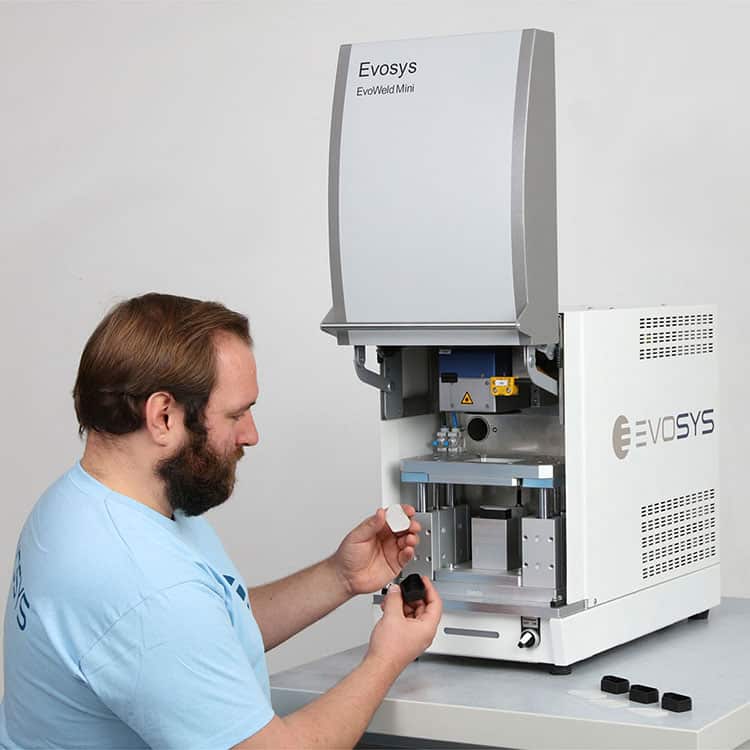
Evosys systems, supplied by TLM Laser, offer multiple process variants to suit different medical device designs:
- Transparent/Absorbing Welding (980 nm wavelength) – Ideal for standard assemblies where one part is laser-transparent and the other is absorptive.
- Transparent/Transparent Welding – EvoClear (1,940 nm wavelength) – Enables welding without absorptive additives, important for fully transparent medical components such as optical sensors or clear diagnostic housings.
- Absorbing/Absorbing Welding – EVO2Step – Used when transparent materials are not an option, often for complex geometries or coloured medical-grade plastics.
Precision clamping tools, advanced collapse control systems, and integrated quality inspection (EvoInspect) ensure welds are both mechanically strong and traceable, meeting the documentation requirements of regulated medical manufacturing.

Applications Across the Medical Industry
Laser plastic welding is used extensively in the production of components where sterility, leak tightness, and dimensional accuracy are paramount. Common applications include syringe hubs and barrels, where weld integrity prevents leakage during injection; microfluidic cartridges used in rapid diagnostics; implantable sensor housings; inhalers and respiratory devices requiring airtight sealing; and fluid management connectors in infusion and dialysis systems.
Evosys technology also enables precision welding of delicate optical or diagnostic assemblies without causing surface damage, ensuring both functional performance and aesthetic quality. In high-volume production environments, the ability to rapidly change fixtures and maintain consistent weld quality reduces downtime and supports lean manufacturing principles.

Key Benefits for the Medical Industry
Laser plastic welding offers several distinct advantages over other joining methods. It provides clean, particle-free joints without introducing foreign materials, preserving biocompatibility. The process generates minimal mechanical stress, protecting delicate internal components such as microelectronics or sensors. Consistency is ensured through inline process control, enabling full traceability of weld quality, a key requirement in regulated markets.
The ability to weld complex geometries and transparent assemblies expands design freedom, while low energy consumption and minimal maintenance contribute to reduced operating costs.

Medical-Grade Plastics with Proven Weldability
The Evosys material compatibility matrix confirms excellent weld performance (++ rating) for a wide range of plastics commonly used in medical manufacturing. These include PEEK for high-performance surgical instruments, PC (polycarbonate) for clear housings and optical parts, PMMA (acrylic) for diagnostic devices, PP (polypropylene) for syringe barrels and disposable connectors, PA 6 and PA 12 for robust mechanical components, and PET for fluidic and packaging applications. Transparent grades of these materials can be paired with absorptive variants for standard laser transmission welding, or with other transparent grades using EvoClear technology. This compatibility gives manufacturers flexibility in material selection without compromising weld integrity.

Explore Evosys Laser Welding Systems with TLM Laser
As the UK and Ireland distributor for Evosys Laser GmbH, TLM Laser provides medical device manufacturers with tailored solutions for both R&D and high-volume production. Our offering includes feasibility studies, process development, turnkey systems, and ongoing service support. From initial concept to validated production, we work with manufacturers to implement welding processes that meet the most demanding quality and compliance standards in the medical industry.
To discuss your application or arrange material testing, contact TLM Laser today and discover how Evosys laser plastic welding can enhance your medical device manufacturing.
Answering Your Questions
Frequently Asked Questions
Laser plastic welding offers several advantages over ultrasonic welding in medical applications. It generates less mechanical stress, which helps protect delicate internal components such as microelectronics or optical sensors. The process also produces cleaner, particle-free welds, reducing the risk of contamination. Additionally, laser welding enables airtight seals and allows welding of transparent components without visible seams, which is important for many diagnostic and drug delivery devices.
Many medical-grade plastics have excellent weldability using laser plastic welding, including PEEK, polycarbonate (PC), polypropylene (PP), polymethyl methacrylate (PMMA), nylon (PA 6 and PA 12), and polyethylene terephthalate (PET). Evosys systems can weld transparent-to-absorbing combinations as well as transparent-to-transparent parts, giving manufacturers flexibility in material choice for applications such as syringe barrels, microfluidic cartridges, inhalers, and diagnostic housings.
Yes. Laser plastic welding is a clean and precise process that produces particle-free joints without adhesives, solvents, or ultrasonic vibrations. This makes it particularly suitable for medical devices where biocompatibility, sterility, and patient safety are critical. When combined with advanced process controls and quality inspection systems, such as those available from Evosys, manufacturers can ensure every weld meets regulatory requirements, including ISO 13485 and FDA standards.
Reviews
Don’t Just Take Our Word for It
Our Customers











Blog Posts
Laser News & Information

Talk to Us!
Connect with our Technical & Support Team.