

Laser Plastic Welding Explained
TLM Laser supplies advanced plastic welding systems from Evosys, tailored for manufacturers across the UK and Ireland. Laser welding offers a non-contact, tool-free method of bonding plastic components with exceptional repeatability and strength. Whether your priority is biocompatibility, aesthetic finish, or long-term reliability, laser welding delivers consistent results across high-performance applications in automotive, medical, and electronics manufacturing.

How Laser Plastic Welding Works
Laser plastic welding uses focused infrared laser energy to create a bond between two thermoplastic components. One part is typically transparent to the laser wavelength, while the other absorbs it. When clamped together, the laser passes through the top layer and is absorbed at the interface, generating localised heat that melts and fuses the materials. Evosys have also developed a technology called ‘Evo2Step‘ where both joining partners can now be laser absorbent.
The process is highly controlled: systems manage pressure, beam shape, power, and motion to deliver uniform energy precisely where it’s needed. Clamping ensures intimate contact at the weld line, while sensors and closed-loop monitoring can verify weld quality in real time. With no moving friction, minimal thermal stress, and no consumables, the result is a consistent, high-strength bond repeatable at scale.


Why Manufacturers Are Switching to Laser Plastic Welding
Traditional joining techniques like ultrasonic welding, vibration welding, or adhesives often fall short in today’s precision manufacturing environments. They can introduce particles, create mechanical stress, or require time-consuming curing processes all of which risk part contamination or compromise.
Laser plastic welding offers a clean, particle-free process that doesn’t require physical contact, mechanical vibration, or consumables. Its ability to create hermetically sealed joints makes it ideal for sensitive components such as sensors, fluidics, and medical enclosures. It also enables complex part geometries and fine weld seams, producing strong yet virtually invisible joins that support both function and finish. With tighter quality demands and growing automation, laser welding has become the go-to joining technology for critical plastic assemblies.

Applications Across Industry
Laser plastic welding is used wherever plastic components must be joined with accuracy, strength, and cleanliness often in regulated or high-performance environments such as medical and automotive. Typical applications include:
Sealed enclosures for electronics, microfluidics, and medical diagnostics, where particle-free assembly is essential.
Multi-layer assemblies in fluid management, filtration, or drug delivery devices, requiring exact weld placement and consistent seams.
Sensors and connectors in automotive or industrial settings, where reliability and vibration resistance are critical.
Aesthetic surface joins in consumer electronics and in-vehicle interfaces, where welds must be strong yet invisible.
Hybrid components combining flexible films with rigid housings, used in packaging or wearable tech.
The flexibility of the process from micro welds to large-format joins allows it to adapt to complex product designs across multiple sectors.
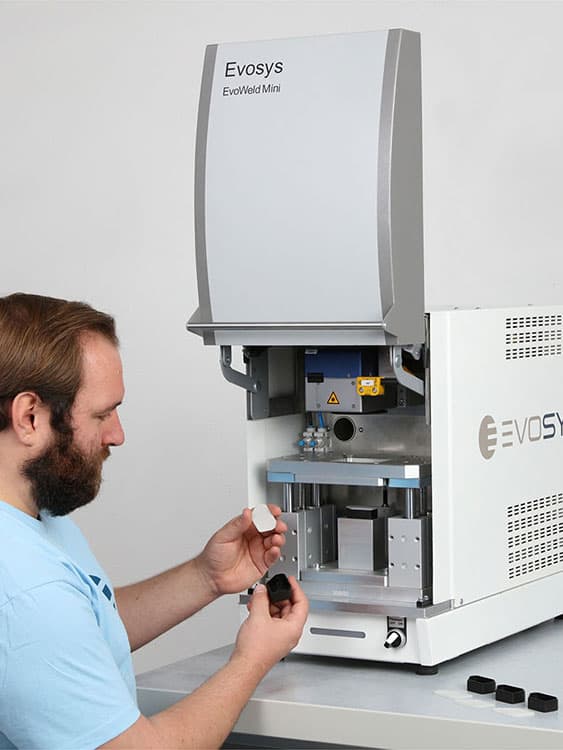
Explore Evosys Laser Welding Systems with TLM Laser
As the UK and Ireland distribution partner for Evosys, TLM Laser provides access to a full range of plastic welding systems, from compact lab units to production-ready automation modules.
Systems like the EVO 2800, EVO 3800, EVOWELD and the EVOWELD-MINI are ideal for standalone applications or pilot production, while integration modules such as the EVO-0800-TD and TD2 allow for direct integration into automated lines. Advanced inspection systems bring smart monitoring, inline process validation, and data traceability essential for regulated environments.
Our team can help you evaluate your application, run sample trials, and specify the right system. Whether you’re prototyping or preparing for high-volume production, we’ll support your journey from proof of concept to factory floor.
Reviews
Don’t Just Take Our Word for It
Our Customers










Blog Posts
Laser News & Information

Talk to Us!
Connect with our Technical & Support Team.